Timer Node
The Timer Node triggers workflow execution at a specified interval. Use it to schedule periodic actions, automate polling, or kick off workflows on a timer.

Configuration
- Interval Mode
- Scheduled Mode
Interval Mode triggers the node at a fixed interval (in seconds).
Interval(s)(number): field to specify how often the node should trigger.Run once(boolean): option to trigger only a single time.Trigger immediately, then repeat(boolean): option to run once as soon as the timer starts.

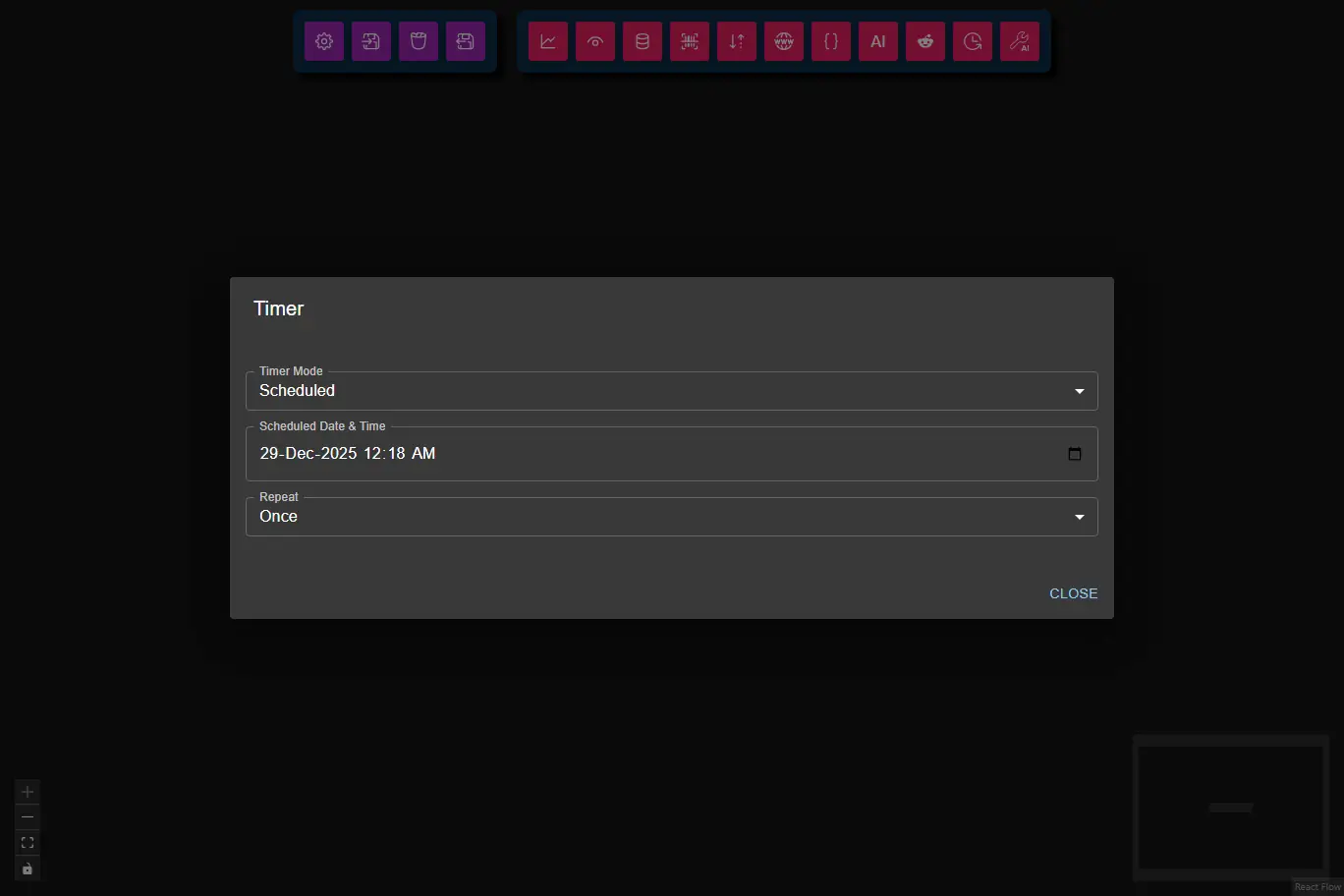
Scheduled Mode triggers the node at a specific date and time, with optional repeat settings.
Scheduled Date & Time(datetime): field to choose when the node should trigger.Repeat(string): set to "Once", "Daily", "Weekly", or "Monthly" for recurring triggers.
Example Usage
For example usage, see the Timeseries Chart workflow, which demonstrates using the Timer Node to fetch data at regular intervals.
Common Use Cases
- Scheduled API Calls: Fetch data from an API every minute.
- Automated Monitoring: Check for changes or updates on a schedule.
- Periodic Processing: Run batch jobs or data transformations at intervals.
Best Practices
- Set a reasonable interval: Avoid very short intervals to reduce resource usage.
- Combine with other nodes: Use with Get Data, AI Processing, or Output nodes for automation.
- Monitor workflow activity: Use Data Flow Spy nodes to inspect outputs.
Troubleshooting
Common Issues
- Node not triggering: For Interval mode, ensure the interval is set and the node is running. For Scheduled mode, check that the scheduled date/time is in the future and the node is enabled.
- Too frequent triggers: Increase the interval value.
- Workflow not starting: Check downstream node configuration and connections.
Performance Tips
- Use longer intervals for heavy or resource-intensive workflows.
- Avoid overlapping triggers by ensuring downstream nodes complete before the next interval.